

How to Brew Better Coffee at Home: A 2026 Guide
Table of Contents
- Start With Fresh, Quality Beans
- The Coffee to Water Ratio Chart Every Home Brewer Needs
- Burr vs Blade Grinder for Coffee: Why It Changes Everything
- Water Temperature and Quality: The Invisible Ingredients
- Step-by-Step: How to Brew Better Coffee at Home
- How to Store Coffee Beans for Freshness
- Coffee Extraction Troubleshooting: Fix Sour, Bitter, or Weak Brews
- Conclusion: Your Daily Ritual, Upgraded
- Frequently Asked Questions
Last Updated: September 22, 2026
Start With Fresh, Quality Beans
Freshness is an important factor in the flavor of your coffee. Grinding beans exposes more surface area to oxygen, so grinding shortly before brewing can help preserve aroma and flavor. Coffee is a agricultural product that begins losing aromatic compounds the day it leaves the roaster.
A common mistake is buying beans in bulk because the unit price looks better. In practice, that "deal" means the last third of the bag gets brewed stale. Buy smaller quantities more often.
What most guides miss is that whole bean coffee stales far slower than pre-ground. Once you grind, the surface area exposed to oxygen multiplies dramatically, and the clock starts running in minutes rather than weeks.
Look for bags with a one-way degassing valve and a printed roast date. If a bag only shows a "best by" date, you have no way to know how long it has been sitting.
At The Gilded Cafe' Co., we offer freshly roasted coffee shipped directly to customers. That timeline matters more than any brewing gadget you can buy.
The Coffee to Water Ratio Chart Every Home Brewer Needs
The coffee to water ratio chart is the fastest fix for inconsistent coffee. Most home brewers eyeball their scoops and wonder why Monday's cup tastes nothing like Sunday's.
A coffee-to-water ratio is the weight of coffee grounds relative to the weight of water, expressed as a ratio like 1:15. Using a scale removes the guesswork that measuring scoops introduces.
| Brew Style | Coffee-to-Water Ratio | Coffee per 12 oz Water | Best For |
|---|---|---|---|
| Pour over | 1:15 to 1:16 | 21-23 g | Bright, clean cups |
| French press | 1:12 to 1:15 | 23-28 g | Full body, rich mouthfeel |
| Drip machine | 1:16 to 1:17 | 20-21 g | Everyday convenience |
| Cold brew concentrate | 1:5 to 1:8 | 43-68 g | Smooth, low-acidity base |
Start at 1:16 and adjust from there. If the cup tastes thin or weak, tighten the ratio. If it tastes heavy or muddled, loosen it.

Weighing your dose and yield on a scale is the difference between a recipe you can repeat and a lucky accident. A $15 kitchen scale does more for your coffee than a $200 grinder if you're currently guessing.
Burr vs Blade Grinder for Coffee: Why It Changes Everything
The burr vs blade grinder for coffee debate ends the same way every time: burr grinders win for anyone chasing consistency. But the reason matters more than the verdict, and it's where most guides stop short.
A burr grinder crushes beans between two rotating surfaces set to a fixed gap, so every particle exits at roughly the same size. A blade grinder chops them like a tiny food processor, and the result is a chaotic distribution: powder, mid-size chunks, and boulders all in the same dose.
That distribution is the whole story. Extraction rate scales with surface area, so fine particles give up their solubles in seconds while coarse ones are still releasing them a minute later. When every particle is a different size, no single brew time can be correct for all of them, the fines over-extract into bitterness while the boulders under-extract into sourness, and you taste both faults in one cup.
What you actually pay for at each tier:
- Blade grinder (entry): Inconsistent by design. Usable for cold brew, where a long steep and a filter forgive the spread, but frustrating for pour over or drip.
- Hand burr grinder (budget): Conical steel burrs, stepped or stepless adjustment, and a consistent grind for a fraction of the cost of an electric burr model. The trade-off is effort, roughly 30 seconds of cranking for a single 20 g dose, more for a full batch. For one or two cups a day, most people find that a fair trade.
- Electric burr grinder (mid to pro): Same burr principle with a motor, plus finer adjustment and repeatability. The jump in price buys speed and consistency across many brews, not a different kind of grind.
A useful way to think about it: a $15 kitchen scale and a hand burr grinder together will outperform an expensive brewer fed pre-ground coffee. Spend on the grinder before you spend on the machine.
Grind size still has to match the method. Finer grinds expose more surface area and extract faster; coarser grinds extract slower. Medium works for drip and pour over, coarse for French press, and extra-coarse for cold brew. Grind right before brewing, the aromatics that make a fresh cup smell alive are the first thing to leave ground coffee.
A budget path that works. If you're starting from nothing, a hand burr grinder, a digital scale, and a basic pour over cone or French press will brew better coffee than a $200 drip machine fed stale pre-ground beans. Upgrade the brewer later; the grinder and the scale are the two purchases that change the cup most per dollar.
Water Temperature and Quality: The Invisible Ingredients
Water temperature control and filtration are the two levers most home brewers ignore, and they're often the reason a good bean tastes mediocre.
The Specialty Coffee Association's brewing standards call for water between 195°F and 205°F. Water below that range under-extracts, producing sour, weak coffee. Water at a rolling boil scalds the grounds and pulls out harsh, bitter compounds.
An inexpensive instant-read thermometer takes the guesswork out. If you don't have one, let a kettle sit for 30 to 45 seconds after it boils before pouring.
Water quality matters just as much. Coffee is roughly 98% water, so off-flavors in your tap water end up in your cup.
Step-by-Step: How to Brew Better Coffee at Home
Learning how to brew better coffee at home comes down to controlling four variables: dose, grind, temperature, and time. Get those consistent and you can brew a great cup with almost any method.
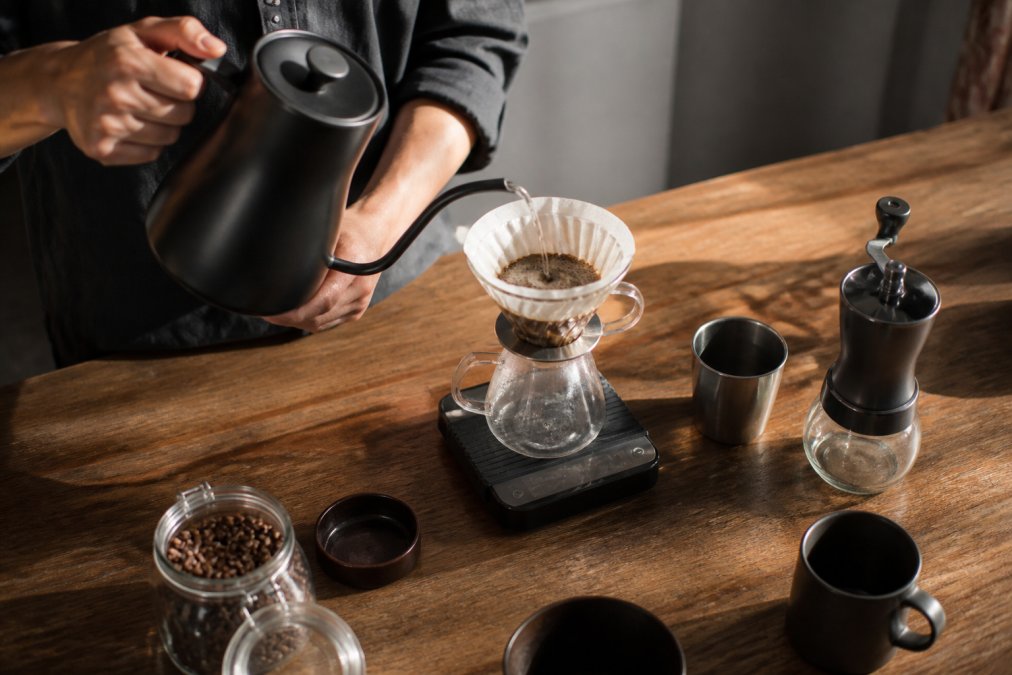
Total time: 8-10 minutes Difficulty: Beginner
What you'll need:
- Whole bean coffee
- Burr grinder
- Digital scale
- Kettle and thermometer (or a temperature-controlled kettle)
- Filtered water
- Your brewer (pour over, French press, or drip)
How to Store Coffee Beans for Freshness
Knowing how to store coffee beans for freshness protects everything you just did right. Oxygen, heat, light, and moisture are the four enemies, and most kitchen storage fails on at least two of them.
Coffee Extraction Troubleshooting: Fix Sour, Bitter, or Weak Brews
Sour, sharp, or salty coffee, under-extraction. Water didn't pull enough from the grounds, so the bright acids and salts dominate before sweetness develops. Fixes, in order of effect:
- Grind finer (biggest lever, more surface area extracts faster)
- Raise water temperature toward 205°F
- Extend brew time or slow the pour
- Increase agitation (stir the bloom, swirl the dripper)
Bitter, harsh, or drying coffee, over-extraction. Too much was pulled, including the bitter compounds that dissolve last. Fixes:
- Grind coarser
- Lower water temperature toward 195°F
- Shorten brew time
- Reduce agitation
Cold brew often produces a smoother-tasting cup with lower perceived acidity than many hot-brew methods. The Gilded Cafe' Co. Cold Brew Coffee is built for exactly that, with chocolate, toffee, and floral notes that hold up well over ice.
Conclusion: Your Daily Ritual, Upgraded
Great coffee at home isn't about expensive gear. It's about controlling four variables consistently: fresh beans, the right ratio, an even grind, and water in the correct temperature range. Master those and every method you try will taste better.
Ready to Brew Better Coffee?
Start with fresh coffee that fits your favorite brewing method. Explore The Gilded Café Co.'s collection of freshly roasted coffees, from smooth blends to single-origin favorites.
→ Explore Our Coffee Collection
Frequently Asked Questions
What is the most effective way to brew better coffee at home?
The most effective approach combines four elements: fresh beans roasted within the last two weeks, a burr grinder for consistent particle size, filtered water heated to 195-205°F, and a precise coffee-to-water ratio. Start with a 1:15 ratio by weight, adjust grind size to control extraction, and taste as you go. Small changes in grind and ratio make the biggest difference in the cup.
Why is a burr grinder better for home brewing?
A burr grinder crushes beans between two rotating burrs, producing uniform particles. A blade grinder chops unevenly, leaving fine dust and coarse chunks that extract at different rates. The result with a blade grinder is often a mix of sour and bitter flavors in the same cup. For anyone learning how to brew better coffee at home, a burr grinder is the single most impactful upgrade.
How does water temperature affect coffee extraction?
Water that is too hot (above 205°F) over-extracts, pulling out harsh, bitter compounds. Water that is too cool (below 195°F) under-extracts, leaving the cup sour and weak. The sweet spot is 195-205°F, which is just below boiling. If you do not have a temperature-controlled kettle, boil water and let it rest for 30-45 seconds before pouring.