

Identifying Specialty Grade Coffee Beans: A 2026 Guide
Table of Contents
- What Specialty Grade Coffee Actually Means
- How SCA Coffee Grading Standards Separate Quality
- How to Read Coffee Bean Labels Without Getting Fooled
- Step-by-Step: How to Identify Quality Beans by Sight and Smell
- Best Coffee Beans for Home Brewing: Matching Roast to Method
- Common Mistakes When Buying Specialty Coffee
- Frequently Asked Questions
Last Updated: September 25, 2026
What Specialty Grade Coffee Actually Means
Specialty coffee refers to coffee recognized for distinctive attributes that give it additional value. Historically, the specialty-coffee industry often used an 80-point threshold on a 100-point scale as a shorthand for quality, but today's SCA framework takes a broader approach that considers a coffee's physical, sensory and informational attributes.
This guide from The Gilded Cafe' Co. covers how to spot the difference before you spend money. Below, we'll show you exactly what graders check, what labels hide, and how to judge beans by sight and smell.
The term gets thrown around loosely. Many bags claim "specialty" without proof. But the standard is real and measurable, set by the Specialty Coffee Association (SCA).
The 100-Point Scale and the 80-Point Threshold
Licensed graders score coffee across categories like flavor, acidity, body, and balance. A total of 80 or above earns the specialty label.
The scale is strict. One flaw can drop a coffee below the line.
Arabica vs. Robusta: Why It Matters for Grading
Arabica has historically dominated specialty coffee, although specialty-grade coffees are not defined solely by species. Robusta, particularly high-quality fine Robusta, can also be evaluated for distinctive qualities.
How SCA Coffee Grading Standards Separate Quality
SCA coffee grading standards work as a green coffee sorting system. Graders examine raw beans before roasting to count defects and measure density.
Here's the practical difference: a sample of 350 grams gets spread out and inspected by hand.
Defect Count, Bean Density, and What Q-Graders Look For
A Q-grader is a certified professional who scores coffee using SCA protocols. They look for:
- Defect count: Zero primary defects allowed for specialty grade
- Bean density: Denser beans signal high-altitude growth and better flavor
- Uniform size: Even beans roast more consistently
- Clean cup: No fermented, moldy, or chemical tastes
How to Read Coffee Bean Labels Without Getting Fooled
A useful label answers five questions: when was it roasted, where exactly did it grow, what varietal is it, how was it processed, and who grew it. If a bag skips most of those, walk away. Marketing words like "gourmet," "artisan," or "small batch" carry no legal definition and no grading requirement behind them. Look for facts instead.
| Label Element | What Good Looks Like | Red Flag |
|---|---|---|
| Roast date | A printed calendar date, ideally within 2-4 weeks | "Best by" only, or no date at all |
| Origin | Country plus region, farm, or washing station | "Blend of origins" with no breakdown |
| Varietal | Named cultivar (Bourbon, Typica, Gesha, Pacamara) | "Arabica" alone |
| Altitude | Meters or feet above sea level (e.g., 1,700-2,000 m) | No elevation listed |
| Process | Washed, natural, honey, anaerobic, or experimental | No process listed |
| Harvest year | Crop year printed (e.g., 2025/2026) | No crop year |
| Cupping score | A number from a licensed grader | Vague quality claims |
Decoding Altitude, Varietal, and Processing Station
Altitude can be a useful piece of information when evaluating coffee, but it is only one factor alongside variety, origin, processing, roasting and other attributes. Coffee grown above roughly 1,200 meters matures more slowly, develops denser cell structure, and typically concentrates more sugar and acidity. A bag that lists 1,800 meters is telling you the beans were grown in the conditions that produce the flavors specialty buyers pay for.
Roast Date, Origin Transparency, and Certifications
Freshness matters more than most buyers realize. Roasted coffee peaks within roughly 2 to 6 weeks of the roast date, depending on roast level and brew method, then fades. A "best by" date is usually set 9 to 12 months out and tells you nothing about when the coffee was actually roasted. Always find the roast date.
Step-by-Step: How to Identify Quality Beans by Sight and Smell
You can judge roasted beans at the counter in about a minute. Use your eyes first, then your nose, then your hands. Most ranking guides stop at "look for even color." That is not enough. The real skill is knowing which specific defects to hunt for, because each one points to a different failure in the supply chain, poor sorting, bad fermentation, insect pressure, or a roast that ran too hot.
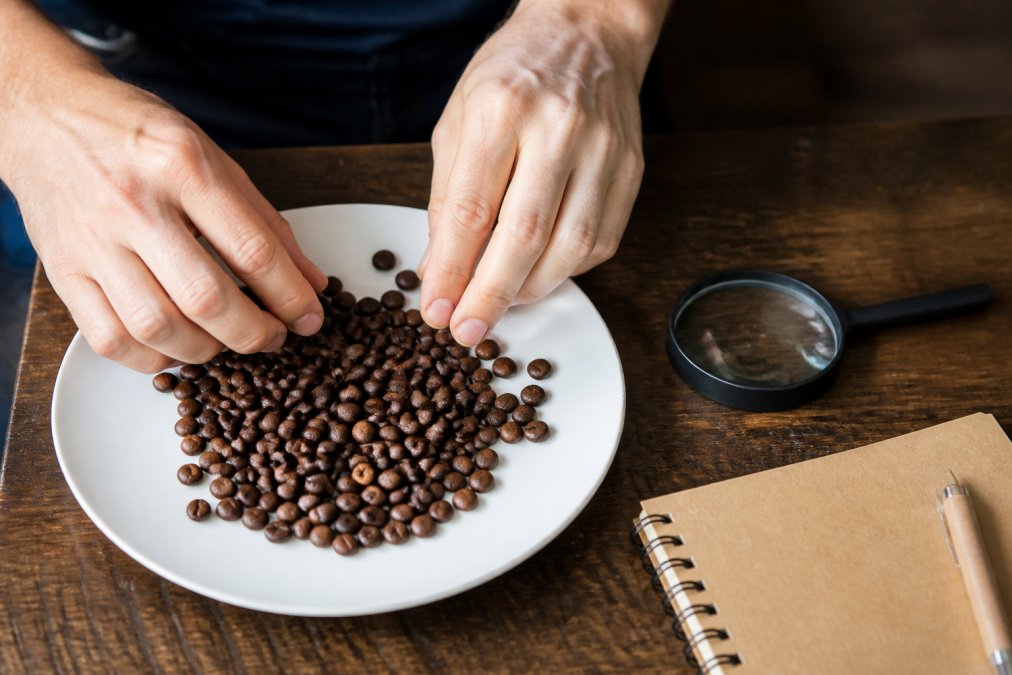
- Spread beans on a light surface. A white plate or paper towel works. You want contrast so pale and dark beans stand out.
- Check for color consistency. Even color across the batch means an even roast. Patches of pale and near-black beans in the same bag mean the roast was uneven or the green coffee was not sorted by density.
- Hunt for the specific defects below. Do not just look for "bad beans", look for the named categories.
- Smell the bag. Fresh coffee smells sweet, complex, and alive. Flat, papery, or cardboard smells mean oxidation. A sharp, vinegary, or medicinal smell points to fermentation defects.
Visual Defect Checklist: What to Look For
These are the defect categories a Q-grader is trained to count. You do not need to score them, but you should be able to spot them:
- Quakers, pale, tan, or light-brown beans that never fully roasted. They taste like peanut skin or wood and dilute the cup. A few are normal; a scattering means poor density sorting.
- Black beans, fully blackened, charred, or ash-like. A primary defect. Even one in a small sample is a red flag.
- Sour beans, dull, yellowish-brown beans with a vinegary or fermented smell. A primary defect tied to bad fermentation or storage.
- Broken or chipped beans, cracked, split, or missing chunks. They roast unevenly and stale faster.
- Insect damage, small round holes, often with a dark rim, bored into the bean. A primary defect.
- Foreign matter, stones, sticks, husks, or bits of string. Any of these in a retail bag is a sorting failure.
- Consistent size, uniform beans roast more evenly than a mix of large and small.
- Oily sheen, expected on dark roasts, a warning sign on light or medium roasts, where it usually means the beans are old or were roasted too aggressively.
Home Cupping Basics: A Simple Sensory Test
Cupping is the standard method professionals use to taste coffee. You can run a simplified version at home in about ten minutes.
Best Coffee Beans for Home Brewing: Matching Roast to Method
The best coffee beans for home brewing depend on your method. A light roast shines in pour-over. A darker roast holds up in espresso.
Here's how to match them:
- Pour-over and drip: Medium-light roasts with bright acidity
- French press: Medium roasts with a rounded body
- Espresso: Medium-dark roasts with low acidity
- Cold brew: Medium to dark roasts with chocolate notes
Common Mistakes When Buying Specialty Coffee
Other common errors:
- Buying from bulk bins where beans sit for weeks
- Choosing dark roasts and assuming they're stronger in quality
- Ignoring origin and process details
- Storing beans in the fridge, which adds moisture and odor
Store beans in an airtight container away from light and heat. Grind right before brewing.
Explore Specialty Coffee for Yourself
Curious about how origin, processing and roast influence your cup? Explore The Gilded Café Co.'s Single Origin coffees and Sample Packs and discover the differences for yourself.
→ Explore Single Origin Coffee
Frequently Asked Questions
What criteria define specialty grade coffee beans?
Specialty coffee is recognized for distinctive attributes that give it additional value. Historically, the industry often used an 80-point score on a 100-point scale as a shorthand for specialty quality, but today's SCA framework takes a broader approach that considers physical, sensory and informational attributes.
How can you tell if coffee beans are high quality by looking at them?
Look for uniform size, consistent color, and a matte surface without oily sheen on lighter roasts. Check for defects: black beans, sour beans, broken pieces, or foreign matter. Also examine the seam for even development. If the bag has a roast date within two weeks and lists a specific origin and processing method, that signals higher quality.
How does the roast date affect the quality of specialty coffee?
Coffee's flavor changes after roasting, and the ideal brewing window varies with roast level, coffee, packaging and brewing method. A roast date is generally more useful than a best-by date when evaluating freshness. Buying from roasters who ship within days of roasting ensures you get the full aromatic profile.
Do specialty coffee beans have to be organic?
No. Organic certification is separate from specialty grade. A coffee can score 85 points and be non-organic, or be certified organic but score below 80. Organic refers to farming practices, while specialty grade refers to cup quality and defect count. Many small farms use organic methods without paying for certification. Look for both if sustainability matters to you, but don't assume organic equals specialty.
Finding truly great coffee takes a little practice, but the payoff is a better cup every morning. At The Gilded Cafe' Co., we source from renowned growing regions and roast in small batches to keep flavor and aroma at their peak. Our single origin coffees and sample packs make it easy to explore what specialty grade really tastes like. Get started with The Gilded Cafe' Co. and taste the difference fresh roasting makes.